

Minnesota May Be Doing the Wrong Kind of Intelligence
The State of Minnesota was reportedly creating dossiers on fraud whistleblowers which tracked their kids. The history of that activity is ugly.

I have spent thirty years doing intelligence work. I sell these skills. I think they are valuable, and I think the people who learn to do them well are doing something worth doing. So when I hear that the Minnesota state government had a guy versed in military intelligence that he wanted to apply to their well-documented social services fraud problems, generally I’m going to think of that as good news.
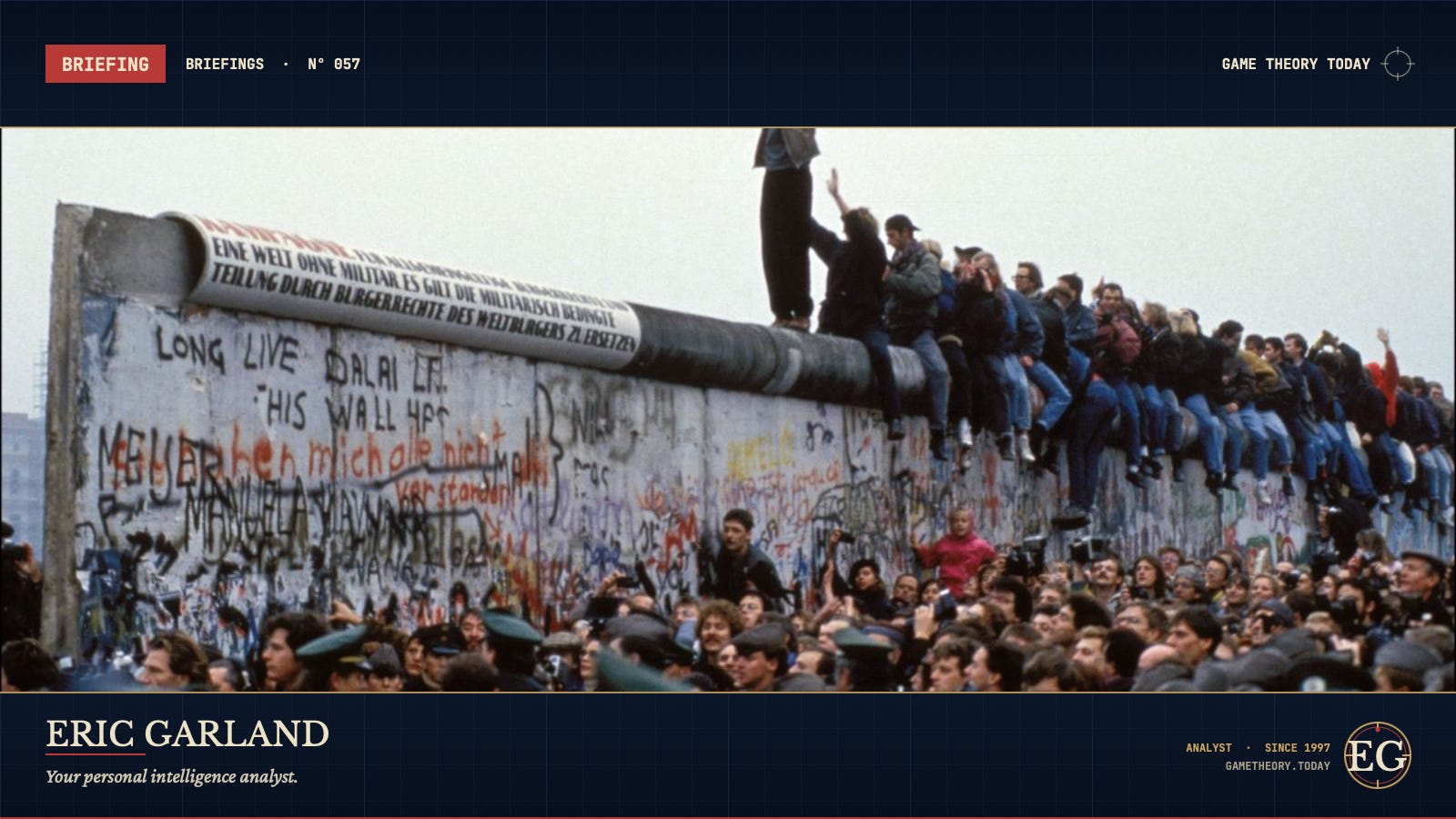
Except it wasn’t good news. His reported proposal was not to point the intelligence apparatus out at fraudsters. It would point inward. At the people reporting the fraud. And their children. Stasi-style, like Dresden or Leipzig back in 1986. Which is when Vladimir Putin was posted there.
The idea that Tim Walz’s Administration was doing likewise is pretty disturbing. Now, it’s subject of a Federal criminal referral from the Vice President.
We need to understand this in full.
A quarter billion in fraud is a lot for any state
Minnesota’s social-service programs got robbed. Food money, health-care money — the kind of programs that exist so that children eat and sick people get care. That is not in dispute and it is not a theory. The Feeding Our Future child-nutrition case alone ran to roughly a quarter-billion dollars, charged by the Justice Department back in 2022, and there are dozens of federal convictions on the board across the state’s programs. Whatever else is argued about, the theft is settled.
What’s under investigation is a different question: what the state government knew, when it knew it, and what it did to the people who tried to say so. That last part is where it stops looking like ordinary government failure and starts looking like something with a Cold War name.
They had an intel guy. He wanted to track the whistleblower, not the fraud.
Here is the documented piece — the part that is on the record, not the part that is alleged. At a House Oversight hearing this spring, members put up an internal email from a manager at the Minnesota Department of Human Services. In his own words, he wrote that he “did intelligence research with the Army,” and offered to use IP and email addresses to track a specific person’s location.
By itself, that’s not particularly bad. It’s what some might call mid-grade cyber intelligence tradecraft—not full blown NSA-style techniques, but a sophisticated approach to de-anonymizing someone who was trying to remain hidden.
That would be OK if it were pointed at potential criminals. And that’s the problem. The person he wanted to track was not a fraudster. It was a state employee who had reported the fraud — someone who could be a witness in a federal proceeding. And the man who wrote that email was later promoted.
A government agency had a capability that derived in part from military intelligence training. It could have pointed that capability outward, at the people stealing from hungry kids. Instead it turned it around and aimed it at the immune system — at the person whose entire offense was telling the truth about the theft.
Sadly, it only gets uglier from there.
Minnesota-style Zersetzung casserole!
The whistleblowers allege more — and I want to be careful here, because this is the part that is alleged, not documented. They say the agency photographed their homes and cars, monitored their devices, and asked which schools their children attend.
Let’s talk about what is already illegal and what just got mind-bendingly creepy.
Whistleblower retaliation is illegal and it’s ugly, but at least it has a logic a bureaucrat understands: you embarrassed the bosses, you get a bad performance review. Now, if you do that intentionally to someone who might testify before a tribunal—especially something that involves Federal programs—you’re talking about a potential criminal charge under 18 USC § 1512—20 years in Federal penitentiary.
And this is way worse. This involved creating dossiers on people’s kids.
The kids don’t come to work. They can’t leak anything, testify to anything, or threaten anyone. The only thing a file on a critic’s children can do is sit there as leverage over the parent.
The East German Stasi had a word for exactly this practice: Zersetzung — “silent decomposition.” They did it for decades. It was learned with loving attention to detail by a certain KGB officer, Mr. Vladimir Putin!
Here’s how it worked: You don’t arrest the dissident. You map their family, their kids, their whole life, and you let them feel that you’ve mapped it. This is what they did instead of out-and-out purges, like during Stalin’s reign of terror. You chose techniques that were more psychological than physical, so instead of arresting troublemakers, you followed their family around—and you let them know it was happening. The point was for the target to know you could reach everyone they love, any time you chose.
A file on a whistleblower’s children is not an investigative tool. In this country, in this century, it has no use except psychological terror.
I wholeheartedly believe in professionals learning intelligence techniques, but I’m a fan of game theory and alternative competing hypotheses, not Zersetzung.
Last night, the Vice President made it a federal question
Then the story moved. The Vice President sent a letter to the head of the Justice Department’s new National Fraud Enforcement Division, asking it to open a criminal investigation into senior Minnesota officials — and the letter specifically names the harassment and intimidation of whistleblowers.
To be cautious, let us be reminded that a criminal referral is not a charge. It’s not a conviction. It is not even an open investigation yet. It is a request that the Justice Department start one. And when the Vice President signs the letter himself, that’s a political signal as much as a legal one — which is precisely why Minnesota’s attorney general is already calling it a stunt and the underlying report “unfounded.”
Both things can be true at once: a referral can be a political act and point at something real.
So strip the politics out and ask the question a professional asks. Is there anything in here with teeth?
Yes — one thread. If the people who reported the fraud are witnesses in federal proceedings, then targeting them isn’t a personnel dispute. It’s obstruction under 18 U.S.C. § 1512 — tampering with a federal witness, up to twenty years. That statute is used constantly, and a jury does not need a law degree to understand why having intelligence operatives map a witness’s children reads as intimidation.
The other thread — that the governor and the attorney general knew about the fraud and lied about it — is the hard one. To get there you have to prove what was inside someone’s head: that they knew it was fraud, didn’t care, and intentionally concealed it. The nearest statute, misprision of felony under 18 U.S.C. § 4, is rarely charged precisely because it requires an affirmative act of concealment, not mere silence. “Knew and did nothing” is a fight over a state of mind. Witness tampering is a fight over what’s in a document. Prosecutors prefer the document.
So if they actually tracked people’s kids and kept it in a file somewhere, I imagine it will find its way before a grand jury.
As always, look to St. Louis for bad examples in real time
If you want to see how the witness-tampering thread plays out in the real world, you don’t have to imagine it. Look at United States v. Montgomery in the Eastern District of Missouri. The former sheriff of the City of St. Louis was first indicted on a federal civil-rights count. Then he was indicted again — for tampering with and retaliating against the witnesses to that first case. His bond was revoked, and he is sitting in federal custody right now, awaiting trial.
Intimidate the witnesses to your alleged crime, and you can catch a second case that’s easier to prove than the first one. That’s not a theory either. It’s an active docket.
What I’m watching
A few things, in the order I trust them.
I’m watching whether DOJ actually opens the case, or whether the referral stays a letter. A letter is cheap. A grand jury subpoena is not.
I’m watching whether the children’s allegations are corroborated by documents or remain a frightened account. If a record surfaces, this gets very serious. If it turns out to be a scared guess, the honest thing is to say so and narrow the story to what the email proves.
And I’m watching myself, frankly. The fraud in these programs predates this fight and the prosecutions started years ago, under a different cast; cleaning up theft from child-nutrition money is not a partisan project, and I’m not interested in pretending the alarm only matters when a convenient official sounds it. The principle I care about doesn’t change with the administration: a government does not get to aim its intelligence capability at the citizens reporting its failures. That was wrong when East Germany did it. It’s wrong in Minnesota. In America, we should not take pro tips from the Stasi.
That’s the standard. Watch which part of this converts from a letter into a case — and watch whether the most damning detail turns out to be the most proven, or the least.
Keep thinking.
»»»»»